About Lake Sentry
A robot that cleans lakes. A campaign that keeps them clean.
Lake Sentry is a student-led project that removes floating trash from Hyderabad's urban lakes, and works to stop it getting there in the first place.
Prevent
Awareness campaign
Educating people to dispose of waste responsibly.
Remove
Lake Sentry V1 robot
A low-cost floating machine that scoops trash off the water.
Connect
LakeSentry.in
Lake reports, community stories and a reviewed initiative network. Try it.
The problem
Floating trash is choking Hyderabad's lakes.
Bottles, bags, wrappers, containers and glass collect on the surface of lakes such as Rangadhamuni, Malkam Cheruvu and Film Nagar Lake. The root cause is improper waste disposal: too little infrastructure, awareness and care.
- Harms habitatsand degrades water quality
- Blocks sunlightthat lakes need to thrive
- Breeds mosquitoesin stagnant, blocked water
- Spoils lakesfor the people living nearby
Scope: floating solid waste. Sewage, industrial discharge and chemical pollution need separate solutions.
Motivation & research
It started with a question at the lakeside.
Instead of only cleaning lakes by hand after pollution builds up, could an affordable machine keep removing floating waste, while awareness efforts tackle the source?
Visits to lakes around Hyderabad showed plastic, packaging and other waste piling up, especially where waste-management infrastructure seemed inadequate. That question became the foundation of Lake Sentry.
Case study: Hussain Sagar
-
1500s
A man-made lake is built
Hussain Sagar is constructed as an artificial lake.
-
Until the 1950s
Almost free of pollution
The lake stays in relatively good condition for centuries.
-
Recent decades
Waste channels, shrinkage, biodiversity loss
Encroachment shrinks the lake and biodiversity is severely lost.
- 1,041 kg/day phosphates
- 1,204 kg/day nitrates
- 4 waste-carrying channels
-
Today
Ground truth from student site visits
Keystone International School students visited Hyderabad lakes and photographed floating trash and land waste around them, matching what secondary sources describe.
Secondary research
Scientific literature and reports on:
- · Plastic pollution
- · Floating waste
- · Freshwater pollution
- · Lake ecosystems
- · Environmental impacts of plastic
- · Waste-management challenges
- · Urban lake pollution
- · India & Hyderabad data
Research on freshwater systems shows plastic pollution isn't limited to oceans: lakes and rivers act as both repositories and pathways for plastic.
Primary research
- Public survey: 40 respondents so far on the waste they see, its causes, how serious it is, support for technological clean-up, and awareness versus individual action.
- Field observations & photos of local lakes.
- Expert interview: Vishal Raj, a Hyderabad environmental activist experienced in lake cleaning.
Interview notes: Vishal Raj, environmental activist
- What is your approach to cleaning water bodies like lakes?
- Look at what a lake needs to survive. The banks need to be strong, so the depth isn't affected and the surface area doesn't shrink.
- What is the root cause of floating pollution?
- People are mostly aware of the problem but take it lightly, as if it's not a big deal.
This matches the survey: the core issue isn't ignorance. Most people already understand the danger. What's missing is the will to act on it.
Remove · the physical solution
Lake Sentry V1: a working prototype.
A remote-controlled floating machine built from CPVC pipe, thermocol floats and a mesh conveyor. Simple, affordable and locally buildable.
- 01 · AimSteer toward floating trash.
- 02 · ScoopThe mesh conveyor lifts it aboard.
- 03 · ReturnPilot back to the bank.
- 04 · RecordWeigh, photograph and time it.
Explore the prototype
Choose a part to see how it works.
Select a part above, or click one in the diagram, to see how it works.
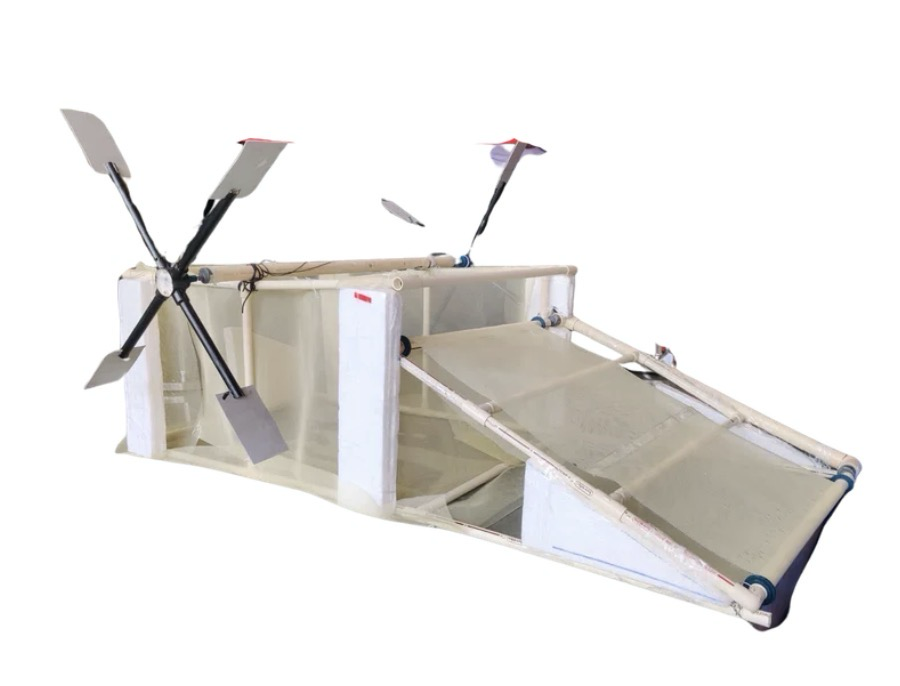

A real engineering fix: the conveyor mesh slipped on its smooth rod and moved waste the wrong way. Adding friction points to the rod made it grip, and it now lifts waste reliably.
Drive V1 in the simulator →What's next
Better, not just bigger.
V2 ideas (proposed, not final): more efficient, reliable, eco-friendly and intelligent.
- ☀️ Solar power
- 🤖 Automation
- 📡 Sensors
- 🗑️ More storage
- ⚙️ Sturdier build
- 🌱 Eco-friendly materials
- 🧩 Modular parts
- 🌧️ Weatherproofing
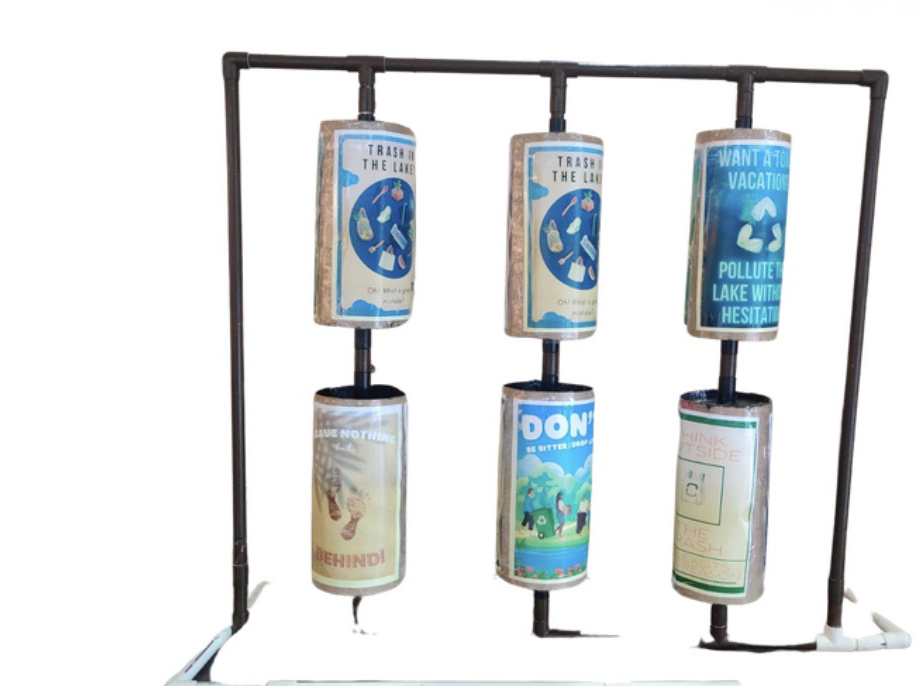
A bot alone can't stop pollution. The root cause is behaviour. So alongside the robot, “The Rollers” installation and Instagram and LinkedIn campaigns spread the message, starting with Hyderabad's young people and college eco-clubs and leading back to LakeSentry.in.
Who it's for
The people who look after lakes.
Not a consumer product. The robot is a tool for organisations that manage lakes, and the campaign speaks to the wider public.
- 🏛️ Government and lake authorities (GHMC, HYDRAA)
- 🏙️ Municipal bodies
- 🌱 Environmental NGOs
- 💼 CSR and nonprofits
- 👥 Local communities and volunteers
UN Sustainable Development Goals
Goals we support.
- 🌊 SDG 6 Clean water6.3 water quality · 6.6 lake ecosystems · 6.b community participation
- 🏙️ SDG 11 Sustainable cities11.6 lower environmental impact of cities
- ♻️ SDG 12 Responsible consumptionless littering, better disposal
- 🐟 SDG 14 Life below watersupporting goal
Lake Sentry contributes to these goals; it doesn't claim to achieve them alone.
More details
Expected impact and how we measure it
- Environment: cut floating trash per km² by 50% or more per lake compared with the first baseline clean-ups; track habitat cleanliness with photos, video and drone imaging; track bird and wildlife species with local partners.
- Society: build partnerships with nonprofits, CSR programmes and local government; grow public awareness; scale clean-ups across the region.
- Core metric: weight of trash recovered per km² for each lake cleaned, compared across lakes to show which need the most attention.
Risks and how we plan for them
| Risk | Mitigation |
|---|---|
| No standing permission to operate on municipal lakes | Partner with HYDRAA / GHMC and lakeside resident associations before each new lake. |
| The monsoon halts clean-ups and can damage electronics | Schedule clean-ups outside peak monsoon months; weatherproof the CPVC frame and electronics housing. |
| An unattended bot at the lake bank could be damaged or stolen | Store it off-site between clean-ups and operate only in supervised sessions until a lockable dock is affordable. |
| Scaling to more lakes needs more than one operator | Train volunteer operators from partner nonprofits and eco-clubs during the pilot phase. |
An honest feasibility check
| Dimension | Current status |
|---|---|
| Technical | V1 demonstrates basic flotation, propulsion, remote control and waste collection in controlled conditions. |
| Economic | The prototype uses simple, accessible components. Costs haven't yet been formally compared with commercial systems. |
| Operational | Battery life, storage capacity and operator needs are still being measured through testing. |
| Environmental | Effects on aquatic organisms, material safety and disposal of collected waste need further evaluation. |
| Social | Survey data shows strong public support for technological clean-up (80% of 40 respondents). |
| Institutional | Relevance to NGOs and government lake bodies is a hypothesis to test through outreach and pilots. |
Lake Sentry does not claim full real-world feasibility until enough field testing has been done.
Sources
- Times of India (5 June 2025). “Hyderabad staring at a mounting plastic pollution crisis.”
- ResearchGate (August 2013). “Aquatic multi-robot system for lake cleaning.”
- SANDRP (17 Feb 2026). “Hyderabad Lakes 2025: Degradation Continues Amid HYDRAA Efforts.”
- Clean-up drive data courtesy of the Dhruvansh Foundation.
- Hussain Sagar: en.wikipedia.org/wiki/Hussain_Sagar
- Official water-body maps: Bhuvan (ISRO) and India WRIS.
- Lake pollution overview: ScienceDirect Topics: Lake Pollution
- Sunlight and lake ecology: Weeders Digest